Supporting your children doesn’t always stop when they turn 18; many parents continue helping their adult children with rent, debt, and other costs, sometimes for years. But this can sometimes come at the expense of the parents’ own financial security and future plans.
To understand how widespread this is and the financial impact it can have on parents, we surveyed 1,019 U.S. adults about the support they give their children, or receive from their parents.
This included how much money parents give, what it pays for, and whether they’ve given anything up to support their adult children. We also asked adults about the support they receive from their parents and how they would manage financially without it.
Key findings
A third (32.2%) of parents with at least one child aged 18 or over provide financial support to their adult child or children.
Parents who financially support their adult children give them an average of $447 a month, and 11.4% give $1,000 or more.
Over the past 12 months, parents estimate they have given their adult children an average of $7,013 in total.
Rent or housing costs and credit card debt are the most common expenses parents help with, both at 89.5%. These are followed by mortgage payments (86.8%) and student loans (84.2%).
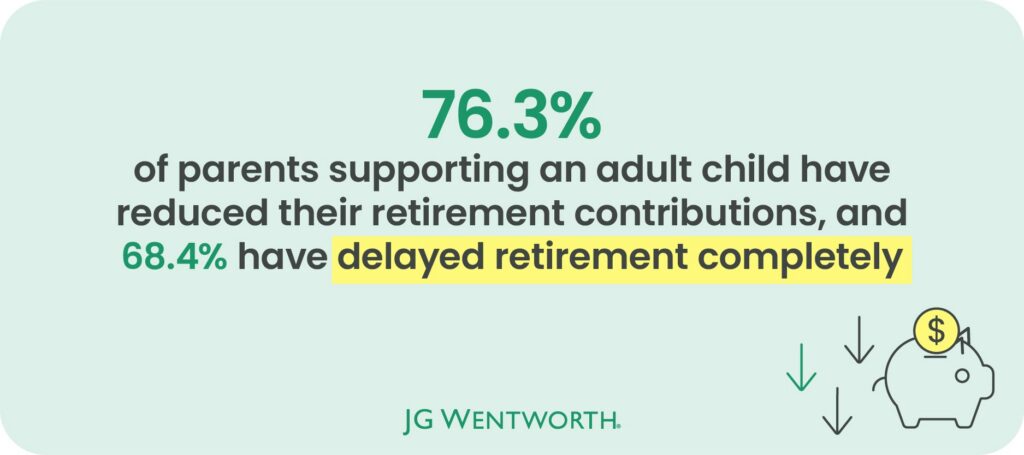
More than three-quarters (76.3%) of parents who support an adult child have reduced their retirement contributions, and 68.4% have delayed their retirement.
71.9% have delayed paying off their own debt to support their adult children, and 67.5% have cut back on investments.
More than a third (36.8%) of parents feel a considerable amount of financial pressure from supporting their adult children. Only 11.4% feel no pressure at all.
Among parents who no longer support an adult child, the most common reason they stopped is that they could no longer afford it (24.8%).
Adults who receive financial support from their parents say they get an average of $554 a month, and 59.6% would find it difficult to keep up their standard of living without it.
Parents who support their adult children
Of the survey respondents with at least one child aged 18 or over, 32.2% say they provide financial support to their adult child or children.
Among these respondents, 27.2% say they provide financial support to one child, making this the most common response. This is closely followed by 26.3% who support two children financially, while just under a quarter (23.7%) of these respondents said they are giving financial support to four or more of their adult children.
The types of expenses parents help towards
Of respondents who support adult children, rent or housing costs and credit card debt are the two most common expenses they help with (both 89.5%). This is followed by mortgage payments (86.8%) and student loans (84.2%).
Support for other costs like groceries, loans and medical care is much less common, with all of these making up less than 3% of responses.
Data note: Respondents could select more than one answer.
Aside from regular expenses that parents help with, we also asked about one-off payments they had made to help their adult children financially. The most common reasons for large one-off payments are rent or housing and car or transportation (both 24.6%).
How much money are parents spending to support adult children?
Among parents who give financial support to their adult children, the average monthly amount they give their child is $447. The most common amount is $250–$499, with 25.4% of parents giving this much, while 11.4% say they give their adult child $1,000 or more per month in financial support.
On average, over the past 12 months, parents estimated that they had given their children $7,013 in financial support.
What parents have given up to support their adult children
The cost of supporting an adult child has an impact on parents’ own finances, and particularly on long-term financial plans. Just over a quarter (26.3%) said that had they not supported their adult children financially, they would definitely have had more money available for their own financial goals.
Just over three-quarters (76.3%) of parents who support an adult child financially have reduced their retirement contributions, and 68.4% have delayed retirement completely due to the added cost of supporting a child.
Debt and investments are also impacted, with 71.9% saying they have delayed paying off their own debt, and 67.5% cutting down on investments.
Reductions in spending on day-to-day expenses like everyday spending (4.4%) and travel and leisure (3.5%) were reported much less often. Only 0.9% of these respondents said they hadn’t given up any of these things to help their children financially.
The financial pressures supporting an adult child puts on parents
Most parents who support an adult child feel some amount of financial pressure as a result; only 11.4% said they experience no pressure.
More than one-third (36.8%) say they feel a lot or a great deal of pressure, while just over a quarter (26.3%) feel a moderate amount of financial pressure.
Parents who previously supported adult children
Among parents who previously supported an adult child financially but don’t anymore, the most common reason they stopped was that they could no longer afford it. Almost a quarter (24.8%) said this was why the support ended.
Around one in five (21.4%) said the decision was mutual, with parent and child agreeing that support should end. A similar share (19.7%) said their child had become financially independent.
Other reasons were less about the parent and more about the child’s circumstances. 17.9% said their child no longer needed the support, and 16.2% said their child had moved to a different financial arrangement.
Alongside almost a quarter of these parents cutting back on support because they could no longer afford it, 65.8% said financially supporting their children affected their own financial plans.
When asked whether they would still choose to give financial support to their children if given the chance again, 24.8% said they definitely would, and 17.9% said they probably would. However, 21.4% said they definitely wouldn’t give financial help to their adult children if they could go back in time and do it again.
Adults receiving support from parents
As well as asking parents about the financial support they give to their children, we also asked adults about financial support they receive from their parents. In our previous study, we found that 77.7% of adults would turn to their parents for support if they needed to borrow money.
Of the survey respondents, 30.9% identified themselves as an adult who regularly receives some sort of financial support from their parents.
Among those who said their parents support them financially, the average amount they said they receive from their parents is $554 per month.
The most common reasons these respondents gave for receiving money from their parents were mortgage payments (93.7%), rent or housing (91.1%), and credit card debt (90.8%).
26.7% of adults are very concerned about the financial impact that supporting them has on their parents
We asked adults who receive financial support from their parents whether they were concerned about the impact this was having on their parents. Just over a quarter (26.7%) said they were very concerned about this, though 19.7% said they were not concerned at all.
Alongside some being concerned that the support they were receiving was putting a financial strain on their parents, others said they would consider changing their spending habits if they thought this strain was significant.
39.4% said they would be very likely or somewhat likely to adjust their spending or financial arrangements if the support they received was impacting their parents’ savings, investments or retirement plans.
Of those who receive financial support from their parents, 20.6% of adults said they would find it extremely difficult to maintain their current standard of living if their parents stopped giving them support, while 20% would find it very difficult, and 19% would find it somewhat difficult.
Methodology
The survey was conducted in October 2026, with 1,019 respondents from diverse backgrounds. It explored parents who give financial support to their adult children, how much they give, and what for, as well as adults who receive financial support from their parents. For some questions, respondents were able to select multiple answers, therefore the results do not all add up to 100%.
Respondents working in marketing or financial services were removed from the dataset.
JG Wentworth is a financial services company that specializes in structured settlement/annuity purchasing and debt relief solutions, among other offerings. For over 30 years, we have established a sterling reputation, including an A+ from the Better Business Bureau, a 4.8 rating with TrustPilot, and 4 stars from Consumer Affairs among countless rave reviews from satisfied customers.
The numbers we provide here are estimates based on some assumptions:
On your own:
Based on industry averages, we estimate a monthly compounding interest rate of 22.99% and that you are making a minimum payment that is 2.5% of your total debt.
JGW:
The length of your program is determined by your debt amount. Programs are between 24 and 60 months in length and average program length is around 42 months.
Savings amount is an estimate base on average customer savings on their monthly payment. Real results will vary and some customers will save more, less or not at all.
Disclaimer: The calculator on this web site is for estimation and educational purposes only. JG Wentworth makes no guarantees regarding its accuracy and specifically disclaims any and all liability arising from the use of this or any other calculator on this web site. Use at your own risk and verify all results with an appropriate financial professional before taking action. We are not registered investment advisers, attorneys, CPA’s or other financial service professionals and do not render legal, tax, accounting, investment advice or other professional services.
Your entered value is significantly different from our estimate. You can adjust it for accuracy, or continue as is.