On this page
What's next




Start Your Free Debt Relief Consultation
Which U.S. States Have the Highest Debt Among Adults Over 60?
•
•
Research shows that the average retired worker received around $23,700 a year in Social Security benefits in 2024. [1] However, it’s estimated that in order for a one-person household to live comfortably in retirement, they will need about $59,600 per year to maintain their lifestyle. [1]
Even in retirement, U.S. adults can feel the impact of rising living costs. According to the Consumer Price Index, prices for all items, including food, electricity, and medical care commodities, increased by an average of 4.2% in the 12 months leading up to May 2026. Some categories experienced much steeper increases, particularly fuel oil (58.9%) and gasoline (40.5%). [2]
Alongside this, our own research into the average lifetime of debt found that debt can follow Americans into retirement, where it typically peaks at age 61.
With this in mind, we set out to discover which U.S. states have the highest amounts of debt among over 60s. To do this, the study analyzed average per-capita balances across four of the most common forms of debt: auto loans, student loans, credit card debt and mortgages. These figures were then compared with the population of residents aged 60 and over in each state to determine where senior adults carry the highest debt burden.
Key findings:
- Utah has the highest amount of debt per person aged over 60, averaging at $28,475 – that’s $18,585 more than the state with the lowest amount of debt per person.
- This is followed by Colorado ($27,704), Washington ($23,406) and Maryland ($22,084).
- Citizens aged over 60 in West Virginia have the least amount of debt per person, averaging at $9,890.
- Following West Virginia, the states with the lowest levels of debt among adults aged 60 and over are Mississippi ($10,820), Kentucky ($11,634), Arkansas ($11,676) and Oklahoma ($12,316).
- The average amount of credit card debt held by a person over 60 in the U.S. is $3,232, but some states – Utah ($4,668), Alaska ($4,636) and Texas ($4,509) – sit well above this average.
- The average mortgage remaining for over 60s across the U.S. is $10,801, but citizens in Utah ($21,177) and Colorado ($21,114) face almost double
Which U.S. state has the highest amount of senior debt?
The study compared the average amount of credit card, auto loan, mortgage and student debt per person aged 60 and over across all states, uncovering where senior adults carry the greatest debt burden in the U.S.| State | Credit card per person over 60 | Auto loan per person over 60 | Mortgage per person over 60 | Student loan per person over 60 | Average amount of debt per person over 60 |
|---|---|---|---|---|---|
| Utah | $4,668 | $2,337 | $21,177 | $294 | $28,475 |
| Colorado | $4,329 | $1,919 | $21,114 | $342 | $27,704 |
| Washington | $3,923 | $1,611 | $17,631 | $242 | $23,406 |
| Maryland | $4,068 | $1,845 | $15,803 | $368 | $22,084 |
| Alaska | $4,636 | $2,013 | $14,570 | $230 | $21,448 |
| Virginia | $3,887 | $1,787 | $15,210 | $335 | $21,219 |
| California | $4,324 | $1,611 | $14,834 | $271 | $21,040 |
| Massachusetts | $3,673 | $1,339 | $13,917 | $326 | $19,255 |
| Texas | $4,509 | $2,930 | $11,045 | $338 | $18,822 |
| Idaho | $3,098 | $1,710 | $13,420 | $242 | $18,470 |
| Nevada | $4,143 | $1,938 | $12,127 | $247 | $18,455 |
| Arizona | $3,426 | $1,808 | $12,773 | $253 | $18,259 |
| Minnesota | $3,094 | $1,480 | $13,251 | $304 | $18,129 |
| New Jersey | $4,131 | $1,486 | $11,971 | $353 | $17,941 |
| Georgia | $4,061 | $2,179 | $11,071 | $422 | $17,733 |
| Oregon | $3,096 | $1,368 | $12,721 | $290 | $17,474 |
| Connecticut | $3,734 | $1,334 | $11,901 | $328 | $17,296 |
| Hawaii | $3,687 | $992 | $12,069 | $181 | $16,929 |
| North Carolina | $3,361 | $1,926 | $10,954 | $306 | $16,548 |
| Wyoming | $2,901 | $1,713 | $11,392 | $156 | $16,162 |
| Delaware | $3,089 | $1,503 | $11,248 | $291 | $16,132 |
| New Hampshire | $3,112 | $1,603 | $11,056 | $277 | $16,048 |
| Tennessee | $3,028 | $1,920 | $10,329 | $281 | $15,559 |
| South Carolina | $3,040 | $1,772 | $10,287 | $306 | $15,406 |
| Illinois | $3,423 | $1,609 | $10,025 | $322 | $15,379 |
| North Dakota | $3,198 | $2,364 | $9,244 | $265 | $15,070 |
| Rhode Island | $3,421 | $1,322 | $9,862 | $289 | $14,894 |
| Florida | $3,534 | $1,741 | $9,255 | $241 | $14,771 |
| Montana | $2,728 | $1,462 | $10,105 | $210 | $14,505 |
| Nebraska | $2,951 | $1,711 | $9,414 | $272 | $14,349 |
| Indiana | $2,736 | $1,734 | $9,428 | $261 | $14,160 |
| New York | $3,747 | $1,326 | $8,455 | $317 | $13,845 |
| South Dakota | $2,610 | $1,670 | $9,010 | $240 | $13,530 |
| Missouri | $2,711 | $1,653 | $8,811 | $266 | $13,441 |
| Louisiana | $2,842 | $2,293 | $7,829 | $319 | $13,283 |
| New Mexico | $2,579 | $2,096 | $8,384 | $192 | $13,251 |
| Kansas | $2,874 | $1,626 | $8,455 | $274 | $13,229 |
| Iowa | $2,442 | $1,657 | $8,853 | $239 | $13,190 |
| Alabama | $2,638 | $1,993 | $8,188 | $286 | $13,105 |
| Michigan | $2,719 | $1,528 | $8,546 | $284 | $13,078 |
| Vermont | $2,509 | $1,701 | $8,573 | $253 | $13,035 |
| Wisconsin | $2,484 | $1,431 | $8,754 | $226 | $12,896 |
| Maine | $2,450 | $1,603 | $8,498 | $234 | $12,784 |
| Pennsylvania | $2,863 | $1,455 | $8,084 | $315 | $12,716 |
| Ohio | $2,667 | $1,731 | $7,704 | $296 | $12,397 |
| Oklahoma | $2,859 | $2,138 | $7,069 | $250 | $12,316 |
| Arkansas | $2,582 | $2,057 | $6,779 | $257 | $11,676 |
| Kentucky | $2,469 | $1,661 | $7,224 | $279 | $11,634 |
| Mississippi | $2,353 | $2,130 | $6,017 | $320 | $10,820 |
| West Virginia | $2,180 | $1,922 | $5,593 | $196 | $9,890 |
Utah has the highest amount of debt per person aged 60+
The research found that Utah has the highest level of debt per person aged 60 and over, with an average debt burden of $28,475. This is $18,585 more than the state with the lowest level of debt among older adults.
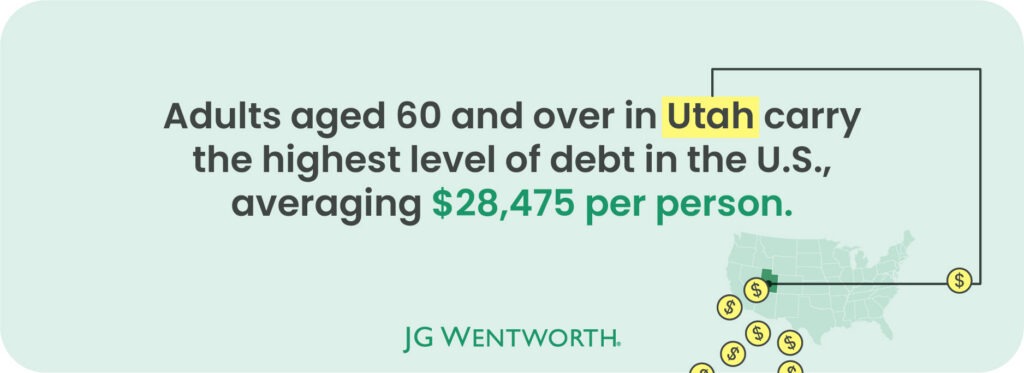
In Utah, adults over 60 have an average outstanding mortgage balance of $21,177, accounting for the largest share of their debt. By comparison, average student debt is relatively low at $294 per person remaining.
Credit card debt among Utah’s over-60 population averages $4,668, while outstanding auto loan balances stand at an average of $2,337.
Rounding out the top five states with the highest levels of debt among adults aged 60 and over are Colorado ($27,704), Washington ($23,406), Maryland ($22,084) and Alaska ($21,448). Despite this, the research also found that Alaska ($36,023) and Maryland ($35,732) have the highest average yearly retirement income across the U.S. [3]
West Virginia has the lowest level of debt among adults aged 60 and over
At the other end of the ranking, the research found that West Virginia has the lowest level of senior debt per person, averaging $9,890. It is also the only state where the total average debt burden among older adults falls below $10,000.
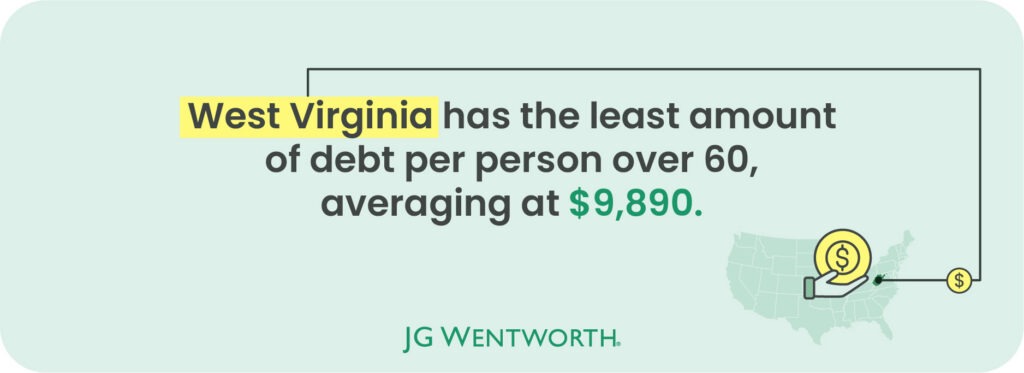
In West Virginia, the average credit card debt held by adults over 60 is $2,180, while average auto loan debt stands at $1,922. Mortgage debt is the lowest recorded in the study, averaging just $5,593 per person, which is $15,583 less than the average mortgage debt held by older adults in Utah. West Virginia also has the second lowest average yearly retirement income amount of $21,118, $7,514 less than is received in Utah ($28,632). [3]
This aligns with reports that suggest West Virginia is 1.36 times less expensive than the average cost of living in the U.S. [4]
Following West Virginia, the states with the lowest levels of debt among adults aged 60 and over are Mississippi ($10,820), Kentucky ($11,634), Arkansas ($11,676) and Oklahoma ($12,316).
Highest debt amounts by debt type
In addition, the research analyzed each debt category separately to identify the states with the highest levels of mortgage, credit card, auto loan and student debt.
Credit card
| Rank | State | Average amount of credit card debt per person over 60 |
|---|---|---|
| 1 | Utah | $4,668 |
| 2 | Alaska | $4,636 |
| 3 | Texas | $4,509 |
| 4 | Colorado | $4,329 |
| 5 | California | $4,324 |
| 6 | Nevada | $4,143 |
| 7 | New Jersey | $4,131 |
| 8 | Maryland | $4,068 |
| 9 | Georgia | $4,061 |
| 10 | Washington | $3,923 |
The research found that over 60s in Utah have the highest average amount of credit card debt per person, at $4,668. This is followed by Alaska ($4,636) and Texas ($4,509), which are both above the national average of $3,232.
To compare the average credit card debt per person across the U.S. ranges from $5,300 to $6,700 per person. [5] This suggests that credit card debt among older Americans remains substantial even in retirement, suggesting that some over 60s may be using credit to help supplement retirement income.
On the other end of the scale, those in West Virginia had the lowest average credit card debt amount per person over 60, at $2,180. Following West Virginia is Mississippi ($2,353) and Iowa ($2,442).
Auto loan
| Rank | State | Average amount of auto loan debt per person over 60 |
|---|---|---|
| 1 | Texas | $2,930 |
| 2 | North Dakota | $2,364 |
| 3 | Utah | $2,337 |
| 4 | Louisiana | $2,293 |
| 5 | Georgia | $2,179 |
| 6 | Oklahoma | $2,138 |
| 7 | Mississippi | $2,130 |
| 8 | New Mexico | $2,096 |
| 9 | Arkansas | $2,057 |
| 10 | Alaska | $2,013 |
When it comes to auto loan debt, the research found that Texas holds the largest share per person over 60. In this state, the average amount is $2,930, $1,938 more than in the state with the least amount of auto loan debt.
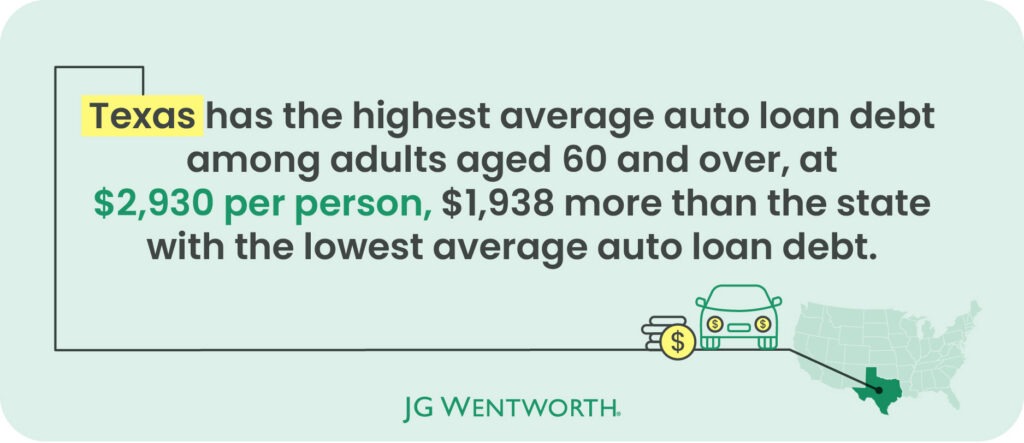
Following Texas is North Dakota ($2,364) and Utah ($2,337) again featuring as one of the most expensive states for debt among over 60s.
In comparison, Hawaii has the least amount of auto loan debt per person aged over 60, averaging just $992. This is $763 below the national average of $1,755.
Rhode Island ($1,322) and New York ($1,326) followed in second and third place.
Mortgage
| Rank | State | Average amount of mortgage debt per person over 60 |
|---|---|---|
| 1 | Utah | $21,177 |
| 2 | Colorado | $21,114 |
| 3 | Washington | $17,631 |
| 4 | Maryland | $15,803 |
| 5 | Virginia | $15,210 |
| 6 | California | $14,834 |
| 7 | Alaska | $14,570 |
| 8 | Massachusetts | $13,917 |
| 9 | Idaho | $13,420 |
| 10 | Minnesota | $13,251 |
When analyzing average outstanding mortgage debt among adults aged 60 and over, the rankings closely mirror the overall debt standings. Utah ranks first, with an average remaining mortgage balance of $21,177 per person, followed by Colorado ($21,114), Washington ($17,631) and Maryland ($15,803). In fact, Utah and Colorado are almost double the national average of $10,801.
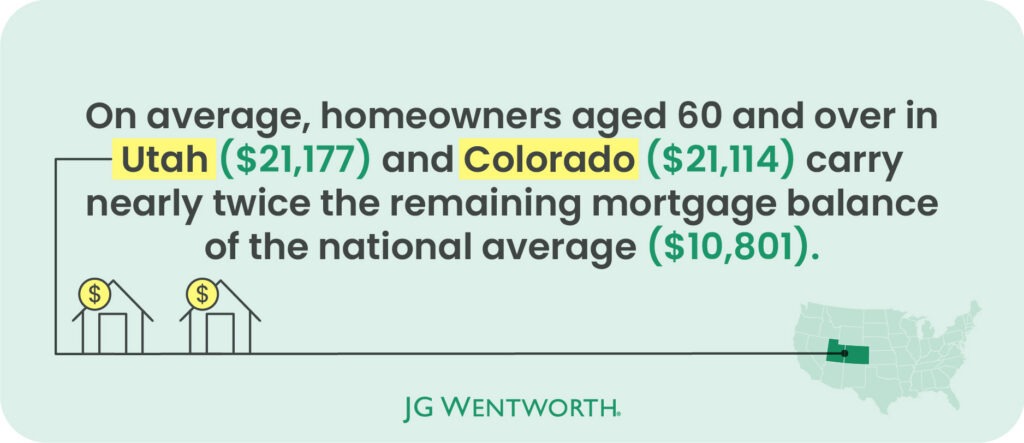
The only changes within the top 10 are that Alaska drops from fifth place overall to seventh place for mortgage debt, while Minnesota enters the top 10 in place of Texas. This suggests that mortgage debt is a major contributor to the overall debt burden carried by older adults across many states.
Student loan
| Rank | State | Average amount of student debt per person over 60 |
|---|---|---|
| 1 | Georgia | $422 |
| 2 | Maryland | $368 |
| 3 | New Jersey | $353 |
| 4 | Colorado | $342 |
| 5 | Texas | $338 |
| 6 | Virginia | $335 |
| 7 | Connecticut | $328 |
| 8 | Massachusetts | $326 |
| 9 | Illinois | $322 |
| 10 | Mississippi | $320 |
Although student loans account for the smallest share of debt among adults aged 60 and over, the research found a considerable difference between states, with a gap of $267 per person between the highest and lowest averages.
Georgia has the highest average level of outstanding student debt among adults aged 60 and over, at $422 per person. This is followed by Maryland ($368), New Jersey ($353) and Colorado ($342).
At the other end of the scale, Wyoming has the lowest average amount of remaining student debt, at just $156 per person. Other states with relatively low levels of student debt among older adults include Hawaii ($181), New Mexico ($192) and West Virginia ($196).
While these figures may appear modest on a per-person basis, the cumulative burden is substantial. When calculated across each state’s entire population aged 60 and over, total outstanding student debt ranges from approximately $24.3 million in Wyoming to an estimated $2.4 billion in California.
Methodology
To estimate the average amount of debt held by residents aged 60 and over in each U.S. state, this study combined state-level debt data with national age-based debt ownership estimates.
Average per capita balances for mortgage, auto loan, student loan, and credit card debt were sourced from the Federal Reserve Bank of New York‘s Household Debt Statistics by State database. These per capita figures were multiplied by state adult population estimates to calculate the estimated total debt held within each state across the four debt categories.
Additional supporting datasets from the Federal Reserve Board, TransUnion, and the U.S. Census Bureau were used to contextualize debt ownership patterns and household characteristics.
To estimate the share of debt held by older adults, national data on debt ownership by age from the Federal Reserve Bank of New York were applied to each debt category. Based on these figures, adults aged 60 and over were estimated to hold 30% of credit card debt, 22% of auto loan debt, 26% of mortgage debt, and 10% of student loan debt nationally.
The estimated debt held by residents aged 60 and over was then calculated for each state by applying these age-based shares to the total debt balances.
Finally, the combined debt total was divided by the population aged 60 and over in each state, using U.S. Census Bureau population estimates, to determine the average amount of debt held per resident aged 60 and over.
Sources
[1] Investopedia, ‘How Much You Need To Retire Comfortably in All 50 States, Based on Your Social Security Check’, 2026
[2] U.S. Bureau of Labor Statistics, ‘Consumer Price Index Summary’, 2026
[3] Smart Asset, ‘What Is the Average Monthly Retirement Income in Every State?’, 2026
[4] Livingcost.org, ‘Cost of Living in West Virginia’, 2026
[5] American Express, ‘Average Credit Card Debt in the U.S.’, 2026

About the author